
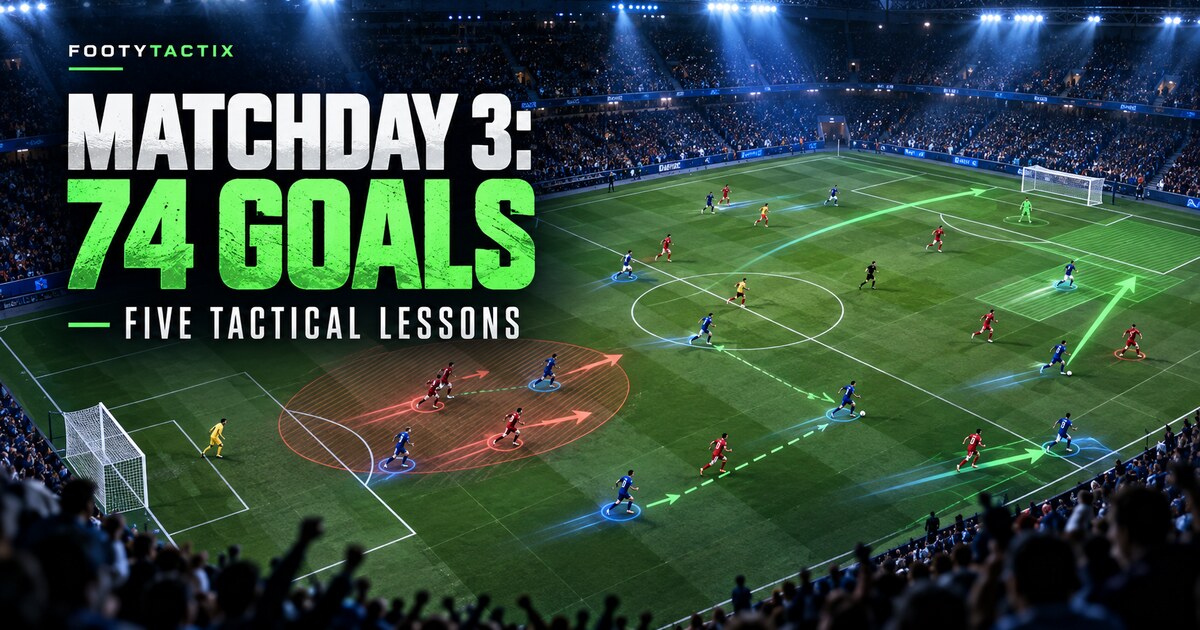
Champions League Matchday 3 produced 74 goals across 18 matches—an average of more than four goals per game. Liverpool defeated Villarreal 4–3, Napoli edged Bodø/Glimt by the same score, Paris Saint-Germain beat Barcelona 4–2, Manchester City overwhelmed AEK Athens 5–1 and Como stunned Manchester United 4–1.
The numbers suggest attacking brilliance, but they also reveal something deeper. Many teams committed large numbers forward, pressed aggressively and left enormous spaces behind their midfield lines. The result was a European matchday shaped by momentum swings, exposed defensive structures and players arriving from unexpected areas.
Here are the five tactical lessons FootyTactix took from an extraordinary week.
1. Pressing only works when the whole team moves together
Liverpool’s 4–3 victory over Villarreal showed both sides of aggressive football. Liverpool began without enough intensity or compactness, allowing Villarreal to play through the first line and attack an exposed defence. The visitors moved 2–0 ahead before Liverpool finally increased the speed and aggression of their press.
Once the distances between Liverpool’s forwards, midfielders and defenders became smaller, the game changed. Villarreal had less time to control possession, Liverpool recovered the ball higher and the pressure around the penalty area became constant. Alexis Mac Allister’s influence and Rio Ngumoha’s direct running helped turn the match around.
However, Liverpool still conceded a late third goal. The lesson is clear: pressing is not simply about running toward the ball. It requires coordinated movement, protection behind the press and immediate reactions when possession is lost. When one part of the structure arrives late, the opponent can escape into open space.
2. Rest defence is becoming one of football’s most important details
Rest defence describes the structure a team keeps behind the ball while attacking. It may not attract the same attention as goals or assists, but Matchday 3 showed why it matters.
Como repeatedly found space when Manchester United lost possession. Nico Paz scored twice and created another goal as United struggled to control the areas behind their attacking players. One of the decisive moments came when Paz regained possession near the touchline, carried the ball forward over a long distance and finished the transition himself.
Barcelona suffered a similar problem against PSG. Their attacking shape placed players high and wide, but the protection underneath those attacks was not always secure. Once PSG broke the first wave of pressure, Barcelona’s defenders were forced to retreat toward their own goal while tracking runners arriving at speed.
A team can dominate possession and still be defensively vulnerable. The important question is not only how many players join the attack, but where the remaining players stand when the ball is lost.
3. Midfield runners are increasingly deciding matches
Several of the matchday’s biggest moments came from players attacking the box from midfield rather than waiting inside it.
Mac Allister scored twice for Liverpool. Scott McTominay scored two goals as Napoli beat Bodø/Glimt 4–3. Declan Rice arrived inside Bayern’s penalty area to score Arsenal’s late equaliser. Phil Foden operated as a fluid central attacker and produced a hat-trick for Manchester City.
These players are difficult to track because they begin outside the defenders’ immediate field of responsibility. Centre-backs are occupied by the central forward, full-backs are pulled toward wide threats and defensive midfielders must decide whether to follow a runner or protect the space in front of the back line.
Well-timed movement can be more damaging than permanent occupation of the penalty area. The best midfield runners wait until defenders look toward the ball, then accelerate into the gap created by that moment of hesitation.
4. Positional flexibility can replace a traditional striker
Manchester City’s 5–1 victory over AEK Athens provided a strong example of attacking without relying entirely on a fixed number nine. With Erling Haaland not starting, Foden moved between the midfield and forward lines rather than remaining in one position.
His movement created uncertainty. If a centre-back followed him, space opened behind the defence. If the defender stayed in position, Foden could receive between the lines, turn and combine with runners. His hat-trick demonstrated how a mobile attacker can become the finishing point of moves without playing as a conventional striker.
This type of flexibility is especially useful against a deep defensive block. Constant rotations force defenders to exchange marking responsibilities, and every exchange creates the possibility of confusion.
5. A convincing scoreline does not always mean complete control
Real Madrid beat Leipzig 4–1, but the final score did not tell the full story. Thibaut Courtois made important saves before Madrid established control, preventing Leipzig from changing the direction of the match.
Liverpool won after conceding three goals. Arsenal earned a valuable 2–2 draw at Bayern but also lost Bukayo Saka early and spent periods defending under pressure. Inter defeated Shakhtar Donetsk 1–0 despite playing with ten men late in the contest.
Results matter, but tactical analysis must look beyond them. A four-goal victory can include vulnerable moments, while a narrow win can demonstrate excellent control and discipline. For FootyTactix, this is why scorelines alone are never enough when assessing future matches.
The FootyTactix view
Matchday 3 was spectacular, but its greatest value comes from understanding why it became so open. Aggressive pressing, adventurous full-backs, midfield runners and flexible attacking roles created chances. Poor spacing, weak counter-pressure and unprotected defensive lines increased the danger at the opposite end.
Those details will matter again on Matchday 4. Teams that correct their rest defence may become more reliable, while sides that continue attacking without protection could produce another round of high-scoring matches.
The goals provided the entertainment. The structures behind them provided the real story.
Related articles


Share this article
Explore today’s predictions
Review the latest match analysis and free selections from FootyTactix.
View Predictions
Comments (0)
No comments yet. Be the first to join the conversation.