
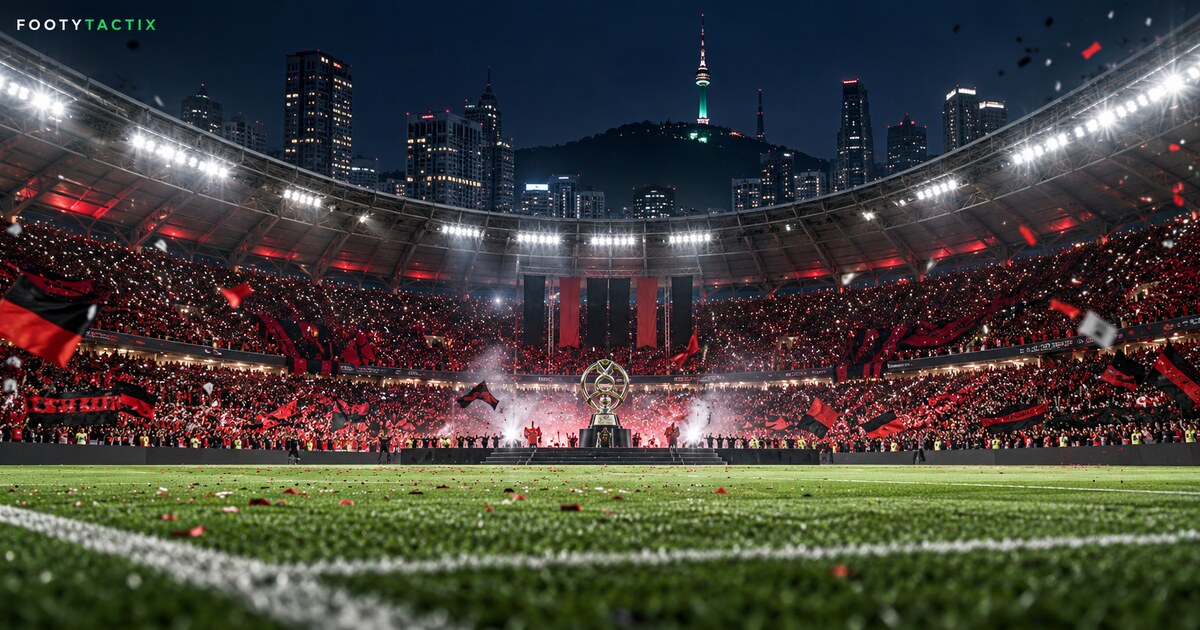
FC Seoul are champions of South Korea again, ending a ten-year wait by securing the 2026 K League 1 title with five matches still to play.
The capital club confirmed its seventh league championship following Saturday’s 1–1 draw with Gangwon FC at Seoul World Cup Stadium. Moon Seon-min gave Seoul the lead in the 58th minute before Kang Joon-hyuck equalised six minutes later, but the point was enough to complete the job.
Confirmed facts
Seoul moved to 67 points from 33 matches, while second-placed Ulsan HD remained 16 points behind after drawing 2–2 with Pohang Steelers. With only 15 points available from the final five fixtures, the defending champions could no longer catch the leaders.
The triumph is FC Seoul’s first K League title since 2016 and the seventh in the club’s history. It also ends a remarkable period in which Jeonbuk Hyundai Motors and Ulsan shared every championship between them from 2017 to 2025.
Seoul’s success has not been built on one narrow strength. Through 33 matches, Kim Gi-dong’s side produced the division’s most effective attack, scoring 61 goals, while also recording its best defensive return with only 29 conceded.
Patryk Klimala has been central to that balance. After injuries restricted the Polish forward during his first season with Seoul, he returned to lead the champions with 16 league goals in 30 appearances. His availability and consistency gave the team a dependable finishing presence throughout the campaign.
Kim, meanwhile, has earned his first K League 1 championship as a head coach in his third season at the club. The achievement represents a significant turnaround for a manager who faced criticism during the previous campaign and again during the early part of this season.
Seoul did not require a victory in the decisive match, but the celebrations reflected the scale of the achievement. Players and coaching staff lifted the championship banner in front of the home crowd before Kim was thrown into the air by his squad.
FootyTactix analysis
The timing of Seoul’s title matters almost as much as the trophy itself. Winning with five matches remaining underlines the distance the club created between itself and the rest of the division.
This was not a championship produced by a short unbeaten burst or a rival’s late collapse. Seoul combined the league’s strongest attack with its tightest defence, giving Kim’s team several ways to control matches. They could dictate possession, attack aggressively or protect a lead without becoming entirely dependent on one tactical approach.
That balance separated them from a chasing group unable to sustain comparable consistency. Ulsan, Jeonbuk and the other contenders dropped points often enough to open the door, but Seoul still had to walk through it. Twenty wins from the opening 33 matches demonstrate how decisively they accepted that opportunity.
The title also disrupts the established K League order. Jeonbuk and Ulsan had controlled the championship for nine consecutive seasons, creating an impression that the league’s biggest prizes belonged exclusively to those two clubs.
Seoul’s return changes that conversation. The capital club now possesses a title-winning structure, an experienced coach and a squad that has performed efficiently at both ends of the pitch.
The next challenge will be sustaining those standards once the immediate celebrations end. Domestic rivals will strengthen, while continental competition will place greater demands on the squad’s depth and ability to manage multiple tournaments.
For now, however, the numbers are decisive. FC Seoul are champions again, and they have ended their decade-long wait in commanding fashion.
Related articles
Share this article
Explore today’s predictions
Review the latest match analysis and free selections from FootyTactix.
View Predictions
Comments (0)
No comments yet. Be the first to join the conversation.