
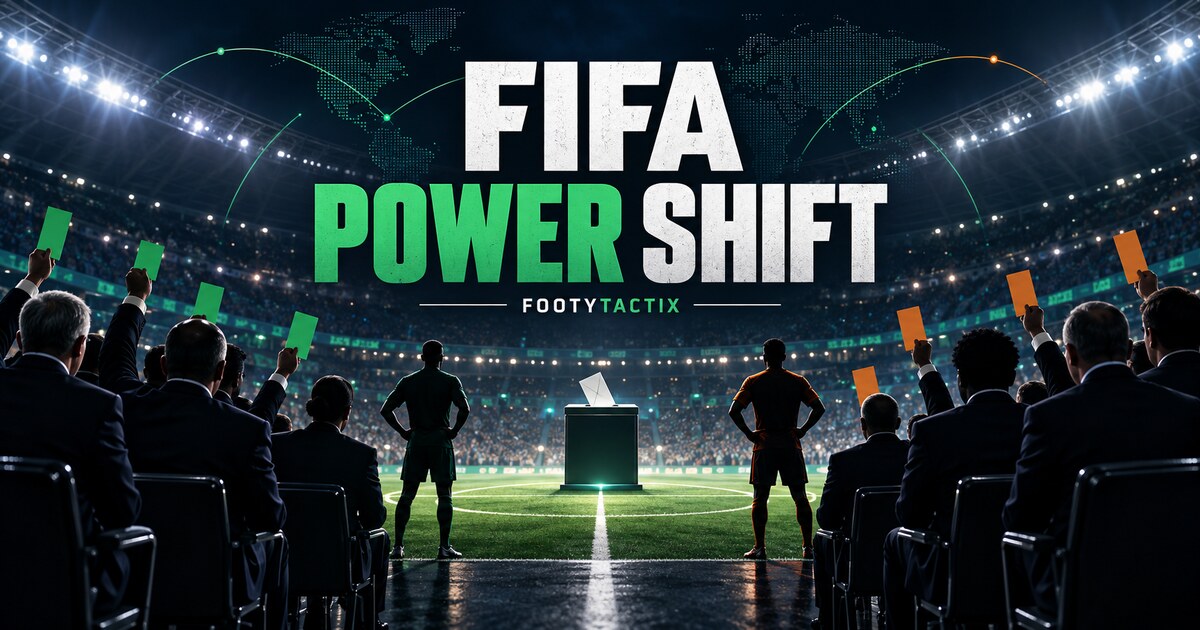
FIFA’s leadership contest has shifted from crisis management to a global count of votes after president Gianni Infantino declared that he retains the backing of the “vast, vast majority” of football’s national associations.
The statement, released on Saturday, October 24, follows one of the most serious governance disputes of Infantino’s presidency. It also arrives at a critical moment: potential challengers have until November 18 to enter the race before FIFA’s presidential election in March.
Confirmed facts
Infantino is seeking a fourth and final term, which would keep him in office until 2031. He has led FIFA since 2016 and argues that the organization’s democratic structure gives each of its 211 member associations an equal voice in deciding who should run world football.
His position came under intense pressure following the collapse of the FIFA Forward Enterprise proposal. The plan sought private investment in a new commercial entity connected to rights from FIFA’s major competitions, including the World Cup. It was abandoned after strong objections from senior football leaders in Europe, Asia, North America, Central America and the Caribbean.
The dispute was not simply about raising money. Critics questioned how the proposal had been developed, who had been consulted and whether FIFA’s most valuable commercial assets could be placed too close to private financial interests. The backlash produced calls for Infantino to step down and raised the possibility of a serious challenge to his leadership.
Infantino apologized to the FIFA Council last week for mistakes in the way the proposal was handled. That apology did not resolve the disagreement. European delegates remained dissatisfied and major associations, including England and Germany, have continued to demand greater clarity over FIFA’s decision-making.
The balance of power changed on Friday when Asian Football Confederation president Sheikh Salman bin Ibrahim Al Khalifa endorsed Infantino for another term. The AFC had previously joined UEFA and CONCACAF in criticizing the abandoned commercial plan, so its new position represents a significant reversal.
Infantino has also said that African associations support his candidacy. With Asia now publicly behind him and no established rival yet in the race, his re-election position appears considerably stronger than it did when the controversy first erupted.
FootyTactix analysis
The immediate story is an election, but the deeper contest is about how global football should be governed.
Infantino’s support rests heavily on FIFA’s one-association, one-vote system. That structure gives smaller football nations the same formal vote as the game’s largest commercial markets. It is one of FIFA’s central democratic principles, but it also creates a political landscape in which continental alliances and development funding can matter more than public criticism from Europe’s most powerful leagues and federations.
The AFC endorsement therefore changes more than the arithmetic. It weakens the idea of a unified international front against Infantino and makes Europe’s opposition look increasingly isolated. Unless critics can agree on a credible candidate before November 18, dissatisfaction may remain loud but strategically ineffective.
That does not mean the governance questions have disappeared. The abandoned investment proposal exposed a fundamental tension inside FIFA: the organization regulates world football while also controlling enormously valuable competitions and commercial rights. Any future attempt to bring private capital closer to those assets will face sharper scrutiny over transparency, consultation and conflicts of interest.
For Infantino, a comfortable victory would demonstrate political resilience, but it would not automatically settle the argument over reform. His opponents will judge him not only by the election result, but by whether FIFA introduces clearer safeguards around major commercial decisions.
What happens next
The November 18 nomination deadline is now the key date. If no credible challenger emerges, the election could become confirmation of Infantino’s restored coalition rather than a true contest. If Europe and its remaining allies produce a candidate, the campaign will become a direct referendum on leadership, transparency and the balance of power between FIFA’s regions.
The confirmed picture is that Infantino remains in office, is seeking another term and has regained important support. The analysis is that the political crisis has eased for the president, but the governance crisis has not. World football may be moving toward continuity at the top, while the argument over who controls its commercial future is only beginning.
Related articles
Share this article
Explore today’s predictions
Review the latest match analysis and free selections from FootyTactix.
View Predictions
Comments (0)
No comments yet. Be the first to join the conversation.